
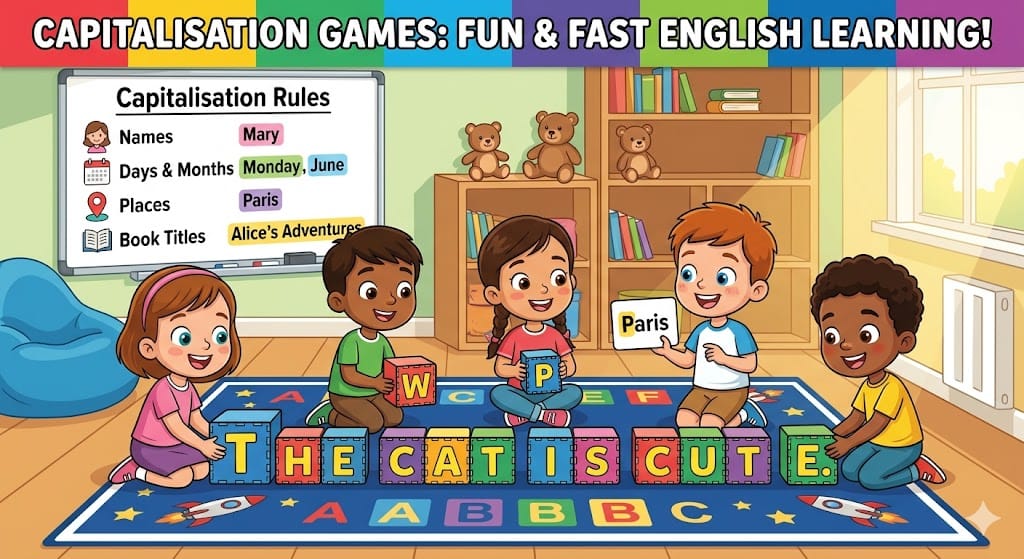
Let’s be honest — when was the last time a child jumped out of their seat with excitement over a grammar worksheet? Probably never. But swap that worksheet for a game, and suddenly the whole energy in the room shifts. Capitalisation might seem like a dry, technical topic, but when you wrap it in play, it becomes something children actually want to engage with. And the best part? They’re learning faster than you might think.
In this article, we’ll explore exactly how capitalisation games accelerate English learning in children, what types of games work best, and how you — whether you’re a parent or a teacher — can use them effectively.
Why Traditional Grammar Lessons Often Fall Flat
Here’s the thing: most children don’t learn well when they’re simply told a rule and asked to memorise it. “Always capitalise the first word of a sentence.” Sure, they can repeat it back to you. But will they apply it when they’re writing their own story? Not always.
Traditional grammar instruction tends to be passive. Children sit, listen, and write. There’s very little emotional investment, no stakes, no excitement. And without those elements, information tends to slide right out of their working memory before it ever gets a chance to stick.
The good news is that there’s a far better way — and it involves something children are already brilliant at: playing.
The Science Behind Learning Through Play
Play isn’t just a break from learning. It is learning. Developmental psychologists and educational researchers have been saying this for decades, and the evidence is pretty compelling.
When children play, they’re actively problem-solving, making decisions, experiencing consequences, and repeating actions. These are exactly the conditions under which deep learning happens. Play creates the kind of meaningful context that makes new information feel relevant and worth remembering.
How the Brain Responds to Game-Based Learning
Think of the brain like a filing cabinet. When information arrives with no emotional tag attached — like a rule read off a whiteboard — it gets filed loosely, easily misfiled or lost. But when information arrives during an exciting game, with a challenge to solve and a reward to earn, the brain tags it with emotion and urgency. That file gets stored somewhere much more accessible.
Game-based learning activates multiple areas of the brain simultaneously. The child is reading, thinking, deciding, and reacting — all at once. This multi-sensory engagement creates stronger neural pathways, which means the information is more likely to be recalled later.
Dopamine, Engagement, and Memory Retention
Every time a child wins a round, solves a puzzle, or earns a point in a game, their brain releases dopamine — the “feel good” chemical. This dopamine hit doesn’t just feel nice; it actually reinforces the behaviour and the knowledge associated with it.
So when a child correctly identifies that “London” needs a capital letter and wins a point for it, their brain essentially says, “That felt great — let’s remember how we did that.” The rule gets encoded not just intellectually, but emotionally. That’s a powerful combination.
Capitalisation Games
What Are Capitalisation Games?
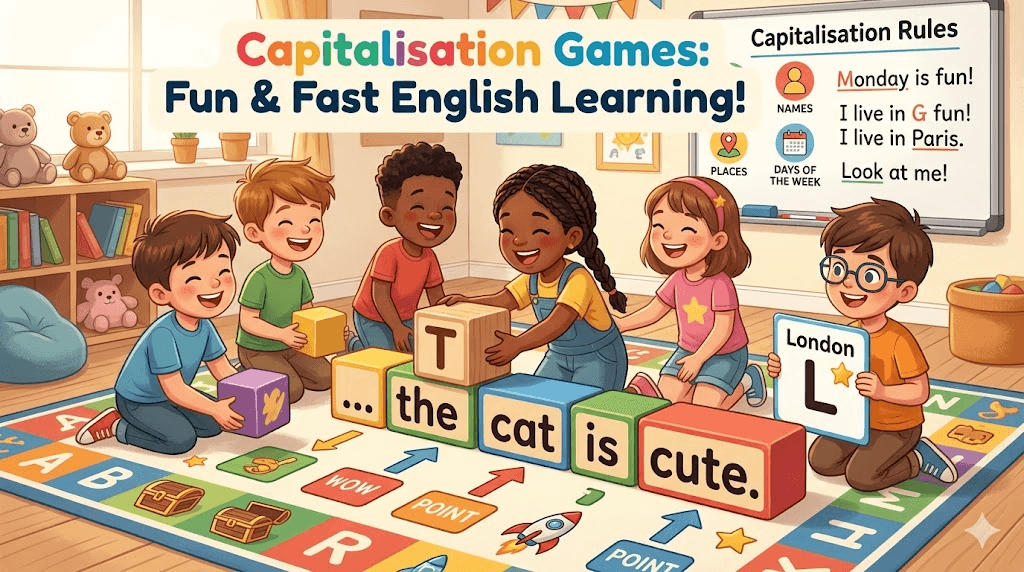
Capitalisation games are structured activities — digital or physical — designed to help children practise the rules of capitalisation in an engaging, interactive way. Rather than completing a worksheet that asks them to “circle the letters that should be capitals,” they might be racing against a timer, competing with classmates, or navigating a story where wrong answers have consequences.
The goal is always the same: to get children to repeatedly encounter, apply, and internalise capitalisation rules without it feeling like a chore.
Types of Capitalisation Games for Children
Not all games are created equal, and different children respond to different formats. Here’s a breakdown of the most effective types.
Digital Capitalisation Games and Apps
There are some genuinely brilliant apps and online platforms that make capitalisation practice feel like playtime. Games like those found on platforms such as Starfall, Education.com, and ABCmouse incorporate capitalisation challenges into broader literacy adventures.
In these games, children might be asked to help a character by correcting sentences, choosing the right version of a word, or typing out properly formatted text. The immediate feedback — a cheerful sound for a correct answer, a gentle prompt to try again for an incorrect one — keeps the learning loop tight and efficient.
Digital games are particularly effective for children who are already comfortable with screens, and they’re easy to use at home without requiring much setup from parents.
Physical and Classroom-Based Capitalisation Activities
Not everything needs a screen. In fact, some of the most memorable capitalisation games are the ones that get children up and moving.
Card sorting games, for instance, ask children to sort word cards into “needs a capital” and “doesn’t need a capital” piles. This hands-on activity forces children to think actively about each word rather than passively scanning a list.
Another favourite is the “Fix It!” game, where teachers display a sentence with deliberate capitalisation errors on the board. Children race to spot the mistakes and correct them. It’s simple, competitive, and surprisingly effective.
Story-Based Capitalisation Challenges
One particularly clever approach is the story-based capitalisation challenge. Children are given a short story — deliberately written without any capital letters — and asked to rewrite it correctly. What makes this work so well is the narrative context. Children are invested in the story, which gives them motivation to read carefully and apply the rules correctly.
You can make this even more engaging by letting children write each other’s stories and then swap them to correct. Suddenly, it’s not just an exercise; it’s a collaborative creative activity with a real audience.
Key Capitalisation Rules Children Learn Through Games
Games are most effective when they’re targeting specific, clearly defined rules. Here are the main ones that children pick up through game-based practice.
Capitalising Proper Nouns
Proper nouns — names of people, places, and organisations — are one of the trickiest concepts for young learners. It’s not immediately obvious why “Sarah” needs a capital but “girl” doesn’t.
Through games that involve characters with names, cities to visit, and teams to join, children encounter proper nouns repeatedly in context. Over time, the pattern becomes intuitive rather than just a memorised rule.
Capitalising the Start of Sentences
This might seem like the most basic rule, but it’s one that children frequently forget when they’re focused on content. Games that involve building sentences — where each new sentence requires a deliberate capital letter decision — help make this an automatic habit.
Titles, Days, and Months
Days of the week, months of the year, and titles like “Mr” or “Dr” all require capitals, but children often overlook these. Calendar-based games, where children fill in weekly schedules or plan fictional events, are a natural and fun way to reinforce these rules.
How to Introduce Capitalisation Games at Home
You don’t need to be a teacher to use these strategies. Here’s how parents can bring capitalisation games into everyday home life:
- Make it part of reading time. When reading together, pause and point out capital letters. Ask your child, “Why do you think that word has a capital letter?” Turn it into a conversation, not a test.
- Use magnetic letters on the fridge. Ask your child to spell out their name, their street, or their school — and challenge them to use capital letters where needed.
- Play “Spot the Mistake.” Write a short message on a whiteboard or piece of paper with a few deliberate errors. Ask your child to find and fix them. Make it silly — the funnier the mistakes, the more engaged they’ll be.
- Try free online games together. Sit with your child and play a capitalisation game on a tablet or computer. Your presence makes it more enjoyable and lets you guide their thinking out loud.
Tips for Teachers Using Capitalisation Games in the Classroom
Teachers, you’ve got a real advantage here — you can design games with your specific class in mind. A few tips:
- Tie games to topics you’re already studying. If you’re learning about countries, create a capitalisation game using country names and cities. Relevance boosts engagement.
- Use peer competition wisely. A little healthy competition is motivating, but make sure every child has a genuine chance to succeed. Consider team-based formats to reduce pressure on individual children.
- Rotate game formats regularly. Children get bored of the same activity quickly. Keep a variety of games in your toolkit — digital, physical, written, and verbal.
- Celebrate effort, not just accuracy. When a child tries hard but makes a mistake, acknowledge their effort before correcting the error. This keeps the emotional association with learning positive.
Measuring Progress: How Do You Know It’s Working?
This is a fair question. Games are fun, but are they actually producing results? Here’s how to tell:
Look at children’s independent writing. Are they applying capital letters more consistently than they were a month ago? That’s your most reliable indicator. You can also use quick, low-stakes quizzes — framed as games, naturally — to assess where each child stands.
Track specific rules rather than overall scores. A child might nail proper nouns but still struggle with sentence starts. Targeted assessment lets you adjust the games you use accordingly.
Common Mistakes to Avoid When Using Capitalisation Games
Even great tools can be misused. Watch out for these pitfalls:
- Overloading on one game type. Variety isn’t just nice to have — it’s essential for comprehensive learning.
- Skipping the explanation. Games work best when children understand why the rule exists. A brief explanation before play helps anchor the learning.
- Ignoring mistakes during games. In the excitement of play, errors can slip by uncorrected. Make sure there’s always a feedback mechanism — whether that’s an app’s auto-correction or a teacher’s gentle intervention.
- Using games as a reward rather than a tool. If games only come out on Fridays as a treat, they lose their educational power. Integrate them regularly into the learning routine.
Conclusion
Capitalisation might be a small corner of the English language, but it carries real weight. It signals the start of ideas, honours the importance of names, and gives writing its proper shape. When children learn these rules through games — through excitement, competition, and play — they don’t just memorise them. They own them.
Whether you’re a parent looking for a fun way to support your child’s literacy at home or a teacher building an engaging classroom, capitalisation games are one of the most effective tools in your arsenal. Start small, stay consistent, and watch how quickly those capital letters start appearing in exactly the right places.
FAQs
1. At what age should children start learning capitalisation rules through games?
Most children are ready to begin exploring capitalisation concepts around age 5 to 6, when they’re starting to read and write simple sentences. Games at this stage should be very visual and low-pressure, focusing on just one or two rules at a time.
2. Are digital capitalisation games better than physical ones?
Neither is definitively better — they work in different ways. Digital games offer instant feedback and are great for independent practice, while physical games encourage social interaction and hands-on learning. Ideally, use a mix of both.
3. How long should a capitalisation game session last for young children?
For children aged 5 to 7, aim for sessions of around 10 to 15 minutes. Older children (8 to 11) can typically sustain focused game-based learning for 20 to 30 minutes. Short, frequent sessions tend to be more effective than long, infrequent ones.
4. Can capitalisation games help children with dyslexia?
Yes, they can be particularly helpful. Game-based learning reduces the anxiety often associated with written tasks, and the repetitive, contextual nature of games helps reinforce rules in a way that traditional instruction sometimes doesn’t. Always consult with a specialist to tailor the approach to the child’s specific needs.
5. What if my child finds capitalisation games too easy or too hard?
Adjust the difficulty! If the game is too easy, add more complex rules or introduce a time pressure element. If it’s too hard, strip it back to one rule and use simpler vocabulary. The sweet spot is a challenge that feels achievable with a bit of effort — that’s where the best learning happens.