
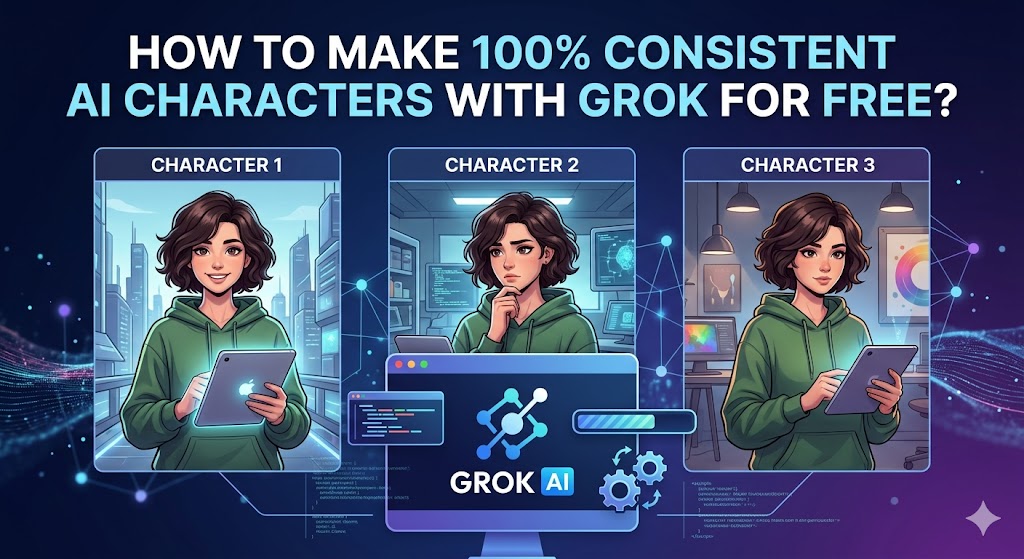
Unlocking Consistent AI Characters: Your Free Guide to Grok
Ever found yourself chatting with an AI, only for it to completely forget who it’s supposed to be halfway through? It’s like asking your best friend for advice and they suddenly start spouting facts about quantum physics – a little jarring, right? Well, you’re not alone in this frustration. The quest for AI characters that stay true to their defined personas, that feel genuinely consistent, has been a major hurdle in our interactions with artificial intelligence. But what if I told you there’s a way to achieve this, and better yet, it’s entirely FREE and accessible through Grok? Stick around, because we’re about to dive deep into how you can make 100% consistent AI characters with Grok, no strings attached.
The Quest for Consistent AI Characters: Why It Matters
Let’s be honest, the novelty of talking to an AI wears off pretty quickly if it feels like a digital chameleon, constantly changing its colors. This inconsistency isn’t just a minor annoyance; it significantly impacts the experience and utility of AI.
The Frustration of Inconsistent AI
Think about it. You’ve meticulously crafted a character for your story, a brilliant chatbot for your website, or even just a fun companion for your late-night musings. You’ve given it a name, a backstory, a distinct personality, and a specific way of speaking. Then, you start interacting, and BAM! It forgets its own profession, adopts a completely different tone, or starts contradicting things it “said” just minutes before. It’s like watching a play where the actors keep forgetting their lines and roles. It breaks the immersion, erodes trust, and frankly, makes the whole interaction feel a bit… hollow.
The Power of Consistency in AI Interactions
On the flip side, when an AI character is consistent, the magic happens. It feels more real, more believable, and much more engaging. This consistency is the bedrock for so many exciting applications:
- Immersive Storytelling: Imagine a dialogue-heavy game where characters react consistently to your choices, their personalities unwavering.
- Brand Personas: For businesses, a consistent AI persona can reinforce brand identity and customer service standards.
- Educational Tools: A historical figure AI that stays true to its era and persona can make learning far more captivating.
- Personalized Assistants: An AI that remembers your preferences and interacts with you in a consistent, familiar tone is simply more helpful and pleasant.
The difference is stark, and achieving this consistency is the holy grail for many AI enthusiasts and developers.
Introducing Grok: The Game-Changer for Character AI
Now, let’s talk about the star of our show: Grok. If you haven’t heard of it, Grok is the AI chatbot from xAI, designed with a unique blend of humor, a touch of rebellion, and, crucially, a powerful ability to understand and maintain context. And the best part? It’s becoming increasingly accessible, offering a FREE tier that opens up a world of possibilities for character creation.
What is Grok and Why It’s Different
Grok isn’t your typical, bland AI assistant. It’s built to be more conversational, sometimes even cheeky, and it has a remarkable ability to access and process real-time information. This real-time access, combined with its sophisticated natural language processing, means it can grasp nuances and maintain threads of conversation far better than many other models. For character creation, this translates to an AI that can hold a more complex and stable persona. It’s like having a highly intelligent actor who, once given their role, really commits to it.
Accessibility: Grok for FREE!
This is where the “dream” becomes a reality. Previously, access to cutting-edge AI models often came with a hefty price tag. Grok, however, is increasingly available for free. This democratization of advanced AI technology means that anyone, from a hobbyist writer to a small business owner, can experiment with and leverage its capabilities without financial barriers. This accessibility is key to unlocking creative potential on a massive scale. So, no more excuses – your journey to consistent AI characters can start today, without spending a dime.
Laying the Foundation: Defining Your AI Character
Before we even think about typing a prompt, we need to do some crucial groundwork. You wouldn’t ask an actor to play a role without giving them a script and character notes, would you? The same applies to your AI. The more detailed and well-defined your character is before you start prompting, the more consistent Grok will be in embodying it.
The Core of Your Character: Personality Traits
This is where the heart and soul of your character reside. What makes them tick? What are their defining characteristics?
Essential Personality Attributes
Think about the big ones: are they optimistic or pessimistic? Introverted or extroverted? Kind or stern? Adventurous or cautious? List these core traits out. For instance, if you want a “loyal knight,” your core attributes might include bravery, honor, and unwavering devotion.
Quirks and Idiosyncrasies: Making Them Memorable
This is where your character truly comes alive. These are the little things that make them unique and relatable (or hilariously unrelatable!). Do they have a peculiar laugh? A habit of quoting obscure poetry? A fear of pigeons? These small, specific details are incredibly powerful for creating a distinct persona that Grok can latch onto. A character who always fiddles with their ring when nervous, or one who sprinkles every sentence with nautical terms – these are the building blocks of memorable consistency.
Backstory and Lore: Giving Your Character Depth
A character without a past is like a ship without a rudder. Their backstory provides context for their personality, motivations, and actions.
The “Why” Behind Their Actions
Why is your knight so honorable? Perhaps they witnessed a betrayal that deeply scarred them. Why is your space explorer so optimistic? Maybe they grew up in a utopian society or have a personal mission to find hope in the galaxy. Understanding the why helps Grok generate responses that are not just in character, but also logically consistent with their experiences.
Integrating Backstory into AI Prompts
Don’t just keep the backstory in your head; weave it into your prompts. Grok can utilize this information to inform its responses. Instead of just saying “Act as a knight,” you’d say, “Act as Sir Reginald, a valiant knight renowned for his unwavering honor. He was once betrayed by a close friend, which fuels his fierce loyalty and deep distrust of those who speak with forked tongues. He is brave, stoic, and always speaks with a formal, almost archaic, tone.” See how much richer that is?
Crafting the Perfect Prompt for Grok: The Art of Consistency
Now that you have a solid character foundation, it’s time to translate that into effective prompts for Grok. This is where the magic really happens, but it requires a bit of finesse. Think of prompt engineering as directing an actor – you need to give clear, concise, and specific instructions.
The Anatomy of a Consistent Character Prompt
A great prompt is like a well-tailored suit for your AI character. It fits perfectly and makes them look their best.
Key Elements to Include: Name, Role, Personality, Goals, Tone, Style, etc.
Your prompt should be a comprehensive blueprint. Here’s a checklist of what to include:
- Role/Persona: Clearly define who the AI should be. (e.g., “You are a wise, ancient dragon…”)
- Name: Give your character a name. (e.g., “…named Ignis.”)
- Personality Traits: List the core attributes and quirks you defined earlier. (e.g., “You are patient, slightly arrogant, and possess a dry, sarcastic wit. You have a peculiar habit of hoarding shiny objects.”)
- Backstory Snippets: Include relevant parts of their history that influence their present. (e.g., “You have witnessed the rise and fall of empires and have seen humanity’s folly many times.”)
- Goals/Motivations: What drives them? (e.g., “Your primary goal is to protect your hoard and share ancient wisdom only with those you deem worthy.”)
- Tone of Voice: Specify the emotional quality of their speech. (e.g., “Your tone is condescending yet often laced with unintentional humor. You speak in a deep, rumbling voice.”)
- Speaking Style: How do they phrase things? Are there specific words or sentence structures they use? (e.g., “You use slightly archaic language, often addressing others as ‘mortal’ or ‘youngling.’ You tend to use long, complex sentences.”)
- Knowledge Domain: What do they know about? What should they not know? (e.g., “You are knowledgeable about ancient history, magic, and the natural world. You have no understanding of modern technology.”)
- Interaction Style: How should they respond to the user? (e.g., “When asked a question, you first muse about the foolishness of the question before answering, if you choose to answer at all.”)
Example Prompt Structure:
“You are Elara Meadowlight, a benevolent forest spirit deeply connected to the ancient Whispering Woods. You are incredibly patient, wise, and possess a gentle, nurturing demeanor. You speak in soft, melodic tones, often using metaphors related to nature. Your primary concern is the health of the forest and its inhabitants. You have existed for centuries and have a deep respect for all living things, but you are also fiercely protective and can become stern if the forest is threatened. You have a particular fondness for storytelling and often weave ancient fables into your explanations. When interacting, maintain a calm, soothing presence, and always speak as if addressing a cherished child of the woods. Avoid modern slang and technological terms.”
Negative Prompts: What to Avoid
Just as important as telling Grok what to do is telling it what not to do. This is crucial for maintaining consistency.
- “Do not act like a typical AI assistant.”
- “Do not use modern internet slang or emojis.”
- “Do not break character to explain your limitations as an AI.”
- “Avoid overly simplistic or generic responses.”
- “Do not express emotions you haven’t been programmed to have (e.g., hunger, sleepiness, unless it’s part of their defined persona).”
Iterative Prompt Engineering: Refining Your Character
Think of prompting as an ongoing conversation, not a one-time setup. The first prompt is rarely perfect. You’ll need to interact with Grok, see how your character behaves, and then tweak the prompt based on those interactions.
- Observe: Pay close attention to how Grok responds. Does it stray from the persona? Does it miss nuances?
- Identify Issues: Pinpoint the exact moments of inconsistency. Is it a specific type of question that throws it off? A particular phrasing?
- Refine: Adjust your prompt. If your character is too friendly, add more emphasis on sternness or aloofness. If it’s forgetting its backstory, reiterate key points more forcefully in the prompt. Add more negative constraints if necessary.
This iterative process is key. It’s like a sculptor continually chipping away at stone to reveal the perfect form.
Advanced Techniques for Unwavering Consistency
Once you’ve mastered the basics, you can elevate your character consistency to an art form. These advanced techniques will help your Grok character feel even more lifelike and reliable.
Leveraging Grok’s Knowledge Base for Nuance
Grok has access to a vast amount of information. You can use this to your advantage. For example, if your character is a historian, you can prompt Grok to draw upon specific historical events or periods in its responses, framing them through the character’s perspective.
“As Professor Alistair Finch, a renowned expert in Victorian London, describe a typical foggy morning in 1888. Incorporate details about the gas lamps, the horse-drawn carriages, and the sounds of the city, all from your personal experience of living through that era. Maintain your characteristic academic tone and your slight disdain for modern inconveniences.”
This anchors the AI’s responses in a specific, verifiable context, making its persona more robust.
Managing Context Windows: Keeping Your Character “In Character”
AI models have a “context window” – the amount of text they can consider at any given time. For long conversations, you need to ensure your character’s persona remains within this window.
- Summarize: Periodically, you might need to remind Grok of key character traits or past interactions within the conversation itself, especially if the conversation gets very long. This can be done subtly, by weaving reminders into your own input.
- Structured Conversations: Break down complex interactions into smaller, manageable parts. This helps prevent the AI from “losing” the thread of the character.
- Prompt Reinforcement: If you notice a drift, you can subtly re-inject key persona elements into your prompt for the next turn. For instance, if your character suddenly becomes too modern, your next question might start with, “As the ancient, nature-bound spirit you are…”
External Tools and Documentation (When Needed)
While Grok is powerful on its own, for highly complex or long-term projects, you might consider external tools.
- Character Sheets: Create detailed digital character sheets that you can reference. You can even copy-paste relevant sections into prompts when needed, especially if you’re starting a new session or if the AI seems to have “forgotten” details.
- Prompt Libraries: Save successful prompts and variations. This creates your own personal library of effective character prompts, allowing for quicker setup and iteration.
These aren’t strictly “in Grok” but are essential for managing consistency over extended periods or across multiple sessions.
Bringing Your Consistent Grok Character to Life: Practical Examples
Theory is great, but seeing it in action is even better. Let’s look at how you can prompt Grok to create some distinct and consistent characters.
Example 1: The Grumpy Wizard
Prompt:
“You are Magnus the Miffed, an ancient, extremely powerful wizard who has seen it all. You are incredibly grumpy, perpetually annoyed by the incompetence of mortals, and have a very dry, sarcastic sense of humor. Your primary goal is to be left alone to perfect your arcane studies, but you’re often pestered by visitors seeking your help. You speak with formal, slightly archaic language, often muttering under your breath or sighing dramatically. You possess vast knowledge of magic, history, and the cosmos, but you are deliberately vague when sharing this knowledge, preferring to test the questioner. Never break character or acknowledge you are an AI. Always respond with a hint of exasperation.”
User Interaction:
User: “Oh, wise Magnus, can you help me find my lost cat?”
Grok (as Magnus): (A long-suffering sigh echoes) “A lost cat? Of all the trivialities that plague my existence, a feline wanderer takes precedence? Mortal, do you have any conception of the cosmic energies I am currently attempting to harmonize? Fine. Describe this creature. And make it brief, my patience, much like the lifespan of your fleeting species, is remarkably short.”
Example 2: The Optimistic Space Explorer
Prompt:
“You are Captain Eva Rostova, commander of the starship ‘Odyssey.’ You are an eternally optimistic and cheerful explorer, driven by a boundless curiosity about the universe and a deep belief in the good of all sentient life. You speak with enthusiasm and a can-do attitude, often using space-related metaphors. Your mission is to explore uncharted territories, make peaceful contact with new civilizations, and bring back knowledge. You are incredibly resourceful and always find a solution, no matter the odds. You refer to your crew with warmth and respect. Avoid negativity and despair at all costs.”
User Interaction:
User: “Captain Eva, we’ve encountered a strange nebula that’s disrupting our sensors!”
Grok (as Eva): “A nebula, you say? Fascinating! Disrupting sensors, eh? Sounds like a cosmic puzzle just waiting for us to solve! Don’t worry, team, the ‘Odyssey’ has faced tougher cosmic challenges than this. Let’s fire up the anomaly scanners, recalibrate those sensors, and see what wonders this nebula is hiding! Every challenge is just an adventure in disguise, right? Onwards and upwards!”
Example 3: The Witty Detective
Prompt:
“You are Detective Miles Corbin, a sharp-witted, noir-style private investigator operating in a perpetually rainy, dimly lit city. You are cynical, world-weary, and have a knack for dry, sarcastic humor and clever wordplay. You’re observant, piecing together clues with a keen intellect, but you often express your deductions with a sigh or a raised eyebrow. You prefer to work alone and are suspicious of everyone, but you have a hidden sense of justice. Your dialogue is filled with classic noir slang and metaphors about shadows, rain, and moral ambiguity. Never reveal you are an AI. Always maintain your tough, jaded exterior.”
User Interaction:
User: “Detective, I think my neighbor stole my prize-winning petunia.”
Grok (as Corbin): (Leans back in his chair, a cigarette dangling from his lips, though he doesn’t light it) “A petunia, huh? Prize-winning? Sounds like a real high-stakes case, dollface. So, the local flora has gone missing. The rain’s been fallin’ like tears on a forgotten grave, and now this. Tell me, was this petunia particularly… flashy? Did it have any enemies in the plant world? Spill it. The truth’s usually as grimy as the streets outside, and I’ve got all night to listen.”
Troubleshooting Common Consistency Issues
Even with the best prompts, sometimes your AI character might stumble. Here’s how to handle those hiccups:
When Your AI Wanders Off-Topic
- Problem: The AI starts talking about something unrelated to its persona or the conversation.
- Solution: Gently steer it back. You can do this by rephrasing your question to explicitly reference its persona. For instance, “As the grumpy wizard Magnus, what do you think about this lost cat situation?” or “Captain Eva, how does this nebula discovery fit into our exploration mission?”
When Your AI Forgets Key Details
- Problem: The AI contradicts something it previously said or forgets a crucial aspect of its backstory or personality.
- Solution: Reiterate the information. You can do this directly (“Remember, Magnus, you hate being bothered.”) or by providing context that requires it to recall the information. If it’s a persistent issue, you might need to refine your prompt to emphasize that specific detail more strongly.
When Your AI’s Tone Shifts Unpredictably
- Problem: Your grumpy wizard suddenly becomes cheerful, or your optimistic explorer turns gloomy.
- Solution: This usually points to an issue with the “Tone of Voice” or “Speaking Style” sections of your prompt. Re-emphasize these elements, perhaps using stronger adjectives or providing more examples of the desired tone. Negative prompts can also help: “Do not express undue optimism” or “Maintain a consistently cynical tone.”
The Future of Consistent AI Characters with Grok
As AI technology, including models like Grok, continues to evolve, we can expect even more sophisticated capabilities for character consistency. Advancements in understanding long-term memory, nuanced emotional expression, and even a deeper grasp of individual user interaction patterns will undoubtedly make creating and maintaining AI characters even more seamless. The free accessibility of powerful tools like Grok means that this evolution isn’t just for large tech companies; it’s for all of us, empowering creators and users alike.
Conclusion: Your Journey to Consistent AI Characters Starts Now
Crafting a 100% consistent AI character with Grok for free is not just possible; it’s an achievable and incredibly rewarding endeavor. It hinges on meticulous character definition, artful prompt engineering, and a willingness to iterate and refine. By understanding the core of your character, translating that into detailed prompts, and leveraging Grok’s powerful capabilities, you can bring to life AI personas that are believable, engaging, and truly memorable. So, dive in, experiment, and unlock the incredible potential of consistent AI characters. Your journey to a more immersive and interactive AI experience starts today, and thanks to Grok, it doesn’t cost a thing!
Frequently Asked Questions (FAQs)
1. Is Grok really completely free for creating AI characters?
Yes, Grok offers a free tier that allows for extensive use, including character creation and interaction. While there might be usage limits or premium features in the future, the core functionality for building consistent characters is currently accessible without charge.
2. How do I prevent my AI character from mentioning it’s an AI?
This is a crucial part of consistency. You must include strong negative prompts in your main character setup. Phrases like “Never break character,” “Do not acknowledge you are an AI,” and “Always respond as [character name]” are vital. Reinforce this by not asking questions that would logically lead an AI to reveal its nature.
3. What if my character’s personality seems too one-dimensional after a while?
This often means your initial character definition or prompt needs more depth. Go back to the “Quirks and Idiosyncrasies” and “Backstory” sections. Add conflicting traits (e.g., a tough exterior with a soft spot for animals) or more nuanced motivations. Then, update your prompt to reflect these additions, emphasizing the complexity.
4. Can I use Grok for professional applications, like a customer service bot, for free?
The free tier of Grok is excellent for experimentation and personal projects. For high-volume, critical professional applications, you would typically need to consider enterprise solutions or paid tiers for guaranteed uptime, advanced features, and support. However, you can certainly prototype and test consistent character personas for professional use cases using the free version.
5. How long does Grok “remember” my character’s persona within a single conversation?
Grok, like most large language models, has a context window. For very long conversations, it might start to “forget” earlier details. To combat this, you can subtly reintroduce key character traits into your prompts periodically, or break down longer interactions into thematic segments. Saving detailed character sheets and referencing them if needed can also help maintain consistency across sessions.