
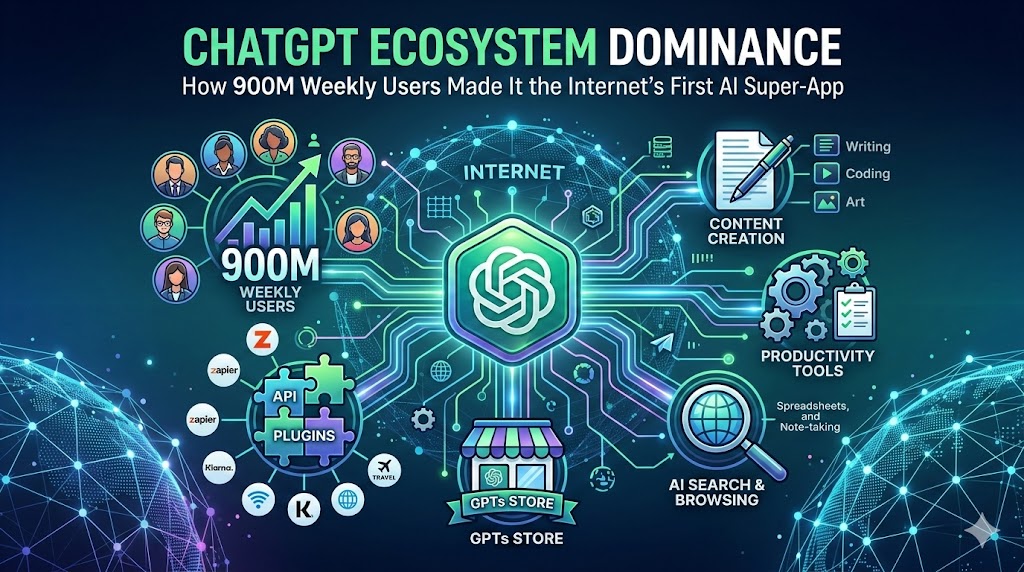
The Dawn of the AI Super-App Era
You know, ChatGPT Ecosystem Dominance it feels like just yesterday we were marveling at the concept of artificial intelligence, whispering about its potential. Now? Well, now it’s not just a whisper; it’s a roar, and at the heart of that roar is ChatGPT. We’re witnessing a seismic shift in how we interact with technology, a shift so profound that we’re essentially seeing the birth of a new category: the AI Super-App. Think about it – the internet has given us super-apps before, platforms that bundle numerous services into one seamless experience. But this is different. This is AI-powered. This is ChatGPT, and with a staggering 900 million weekly users, it’s not just a player in the AI game; it’s the undisputed champion, the first true AI super-app that’s redefining our digital lives.
Defining the AI Super-App: More Than Just a Chatbot
So, what exactly is an AI Super-App? Is it just a fancy chatbot? Absolutely not. While ChatGPT started as a sophisticated conversational AI, its evolution has far outpaced that initial definition. An AI Super-App is a platform that leverages advanced artificial intelligence to offer a broad spectrum of functionalities, moving beyond a single-purpose tool to become an indispensable, all-encompassing digital assistant. It’s an app that doesn’t just do things; it understands, learns, and anticipates, becoming an extension of our own cognitive abilities. It’s the difference between a calculator and a personal tutor who can also draft your emails, plan your vacations, and even debug your code. It’s about integration, intelligence, and an ever-expanding utility belt.
What Makes an App a “Super-App”?
The term “super-app” itself isn’t entirely new. We’ve seen it applied to platforms like WeChat in China, which started as a messaging app and evolved into a do-it-all behemoth for social networking, payments, shopping, and more. The key ingredients for a super-app are:
- Breadth of Functionality: It offers a wide array of services, often integrating third-party tools.
- Seamless Integration: These services work together harmoniously within a single interface.
- User Habit Formation: It becomes so integral to daily life that users can’t imagine their digital routines without it.
- Strong Ecosystem: It fosters a community of developers and users who contribute to its growth and utility.
ChatGPT is ticking all these boxes, but with an AI twist that amplifies each characteristic. It’s not just about adding features; it’s about infusing intelligence into every interaction, making the experience more intuitive, powerful, and, dare I say, magical.
ChatGPT’s Unprecedented Rise to 900M Weekly Users
Let’s talk numbers, because 900 million weekly users is not just a number; it’s a phenomenon. Think about the most dominant apps you use daily – social media giants, productivity suites. Even they didn’t reach this kind of active weekly user base with such astonishing speed. What was the secret sauce? How did a tool that, in some ways, still feels bleeding-edge, become so deeply embedded in the fabric of our online lives within such a short timeframe?
The Viral Spark: From Novelty to Necessity
It all started with a bang. When ChatGPT was first released, it was the hottest topic on the internet, eclipsing even the most viral memes. People were sharing screenshots of their conversations, amazed by its ability to write poems, explain complex topics, and even generate code. It was the ultimate digital party trick. But the magic didn’t stop there. That initial novelty quickly morphed into genuine utility.
Early Adopter Buzz and Mainstream Appeal
The early adopters – developers, writers, students, professionals – quickly realized ChatGPT wasn’t just a toy. They started integrating it into their workflows. A programmer could use it to debug code faster, a marketer to brainstorm campaign ideas, a student to understand a difficult concept. This buzz, amplified by social media, created a powerful network effect. As more people saw its practical applications, the barrier to entry lowered, and mainstream users, initially curious, found themselves discovering its value for everyday tasks – from drafting emails to planning meals. It was a brilliant cascade of curiosity turning into genuine reliance.
A Foundation Built on Accessibility and Utility
OpenAI, the creators of ChatGPT, understood a crucial principle: to achieve mass adoption, the technology needed to be accessible and undeniably useful. They didn’t bury ChatGPT behind complex interfaces or require a Ph.D. to operate. Instead, they offered a clean, intuitive chat window that felt as familiar as texting a friend. Combined with its remarkably versatile abilities – which we’ll dive into more – this user-friendly approach was the bedrock upon which its massive user base was built. It lowered the perceived complexity of AI and made its power available to virtually anyone with an internet connection.
Beyond the Chat Interface: The Expanding ChatGPT Ecosystem
If ChatGPT were just a chatbot, it might have remained a popular tool. But OpenAI didn’t stop there. They recognized that to become a true super-app, ChatGPT needed to evolve, to become a platform in itself, a central hub from which countless other functionalities could be accessed and integrated. This is where the ecosystem truly comes into play, transforming the app from a singular entity into a boundless universe of possibilities.
Plugins: Unlocking a Universe of Capabilities
Remember when plugins first revolutionized web browsers? ChatGPT’s plugin store is doing something similar, but for AI. Suddenly, ChatGPT isn’t limited to the knowledge it was trained on or the basic functions it can perform. With plugins, it can interact with the real world. Think about it:
- Travel Planning: A plugin can access flight and hotel booking sites to plan your entire trip.
- Shopping: It can browse e-commerce sites, compare prices, and even find deals.
- Data Analysis: It can connect to spreadsheets and perform complex data analysis.
- Learning: It can access academic papers or news articles to provide up-to-date information.
This ability to connect to external services is a game-changer. It’s like giving your AI assistant access to the entire internet and beyond, turning it into a universal remote control for your digital life.
How Plugins Transform ChatGPT into a Versatile Tool
The power of plugins lies in their ability to extend ChatGPT’s core intelligence to specific, real-world applications. Instead of just telling you about a recipe, a cooking plugin can find recipes online, generate a shopping list, and even provide step-by-step instructions with integrated timers. Instead of just describing a stock market trend, a finance plugin can pull live data, analyze it, and offer insights. This is where the AI super-app concept truly shines – it’s not just a tool that simulates understanding; it’s a tool that acts upon that understanding by interacting with other digital services.
Custom GPTs: Personalization at Scale
If plugins opened doors to external services, Custom GPTs have unlocked the potential for hyper-personalization. Imagine being able to create your own specialized AI assistant, tailored to your unique needs, interests, or profession. That’s the power of Custom GPTs. Developers and even everyday users can now build GPTs for specific tasks. Want an AI to help you write in the style of Shakespeare? Or an AI that’s an expert on obscure historical facts? Or one that acts as a personalized coding tutor for a specific language? You can build it. This democratizes the creation of AI tools and allows users to curate their own bespoke AI experiences, further cementing ChatGPT’s role as a central, customizable AI hub.
The API and Developer Ecosystem: Fueling Innovation
Beyond the user-facing features, OpenAI has also fostered a robust developer ecosystem through its API. This allows businesses and independent developers to integrate ChatGPT’s powerful AI capabilities into their own applications and services. This is critical for a super-app. It means ChatGPT isn’t just confined to its own interface; its intelligence is being woven into countless other platforms, from customer service bots to educational software. This widespread integration not only expands ChatGPT’s reach but also fuels innovation, as developers find new and creative ways to leverage its capabilities, leading to a virtuous cycle of development and adoption.
Why 900 Million Users Can’t Be Wrong: The Core Value Proposition
So, what is it about ChatGPT that has captured the attention and loyalty of such an enormous global audience? It boils down to a powerful, multifaceted value proposition that addresses fundamental human needs in the digital age. It’s not just about novelty; it’s about substance.
Democratizing Access to Advanced AI
For so long, cutting-edge AI felt like something confined to research labs or highly specialized tech companies. ChatGPT blew that door wide open. Suddenly, powerful natural language processing, complex reasoning capabilities, and creative content generation were accessible to anyone with an internet connection and a willingness to type. It’s like giving everyone a key to a vault of knowledge and creative power that was previously locked away. This democratization is arguably its most significant contribution, leveling the playing field and empowering individuals in ways previously unimaginable.
Bridging the Gap Between Human Intent and AI Execution
Have you ever struggled to get a computer to do exactly what you want? With traditional software, you often have to learn its specific language, its commands, its quirks. ChatGPT, however, speaks your language. You can articulate your needs, your ideas, your problems in plain English (or virtually any other language), and ChatGPT can understand and execute. This intuitive interaction bridges the gap between what we want and what the technology can do. It transforms complex tasks into simple conversations, making technology more human-centric and less intimidating.
The Power of Generative AI for Everyday Tasks
Generative AI, the engine behind ChatGPT, is a powerhouse for creation and problem-solving. This translates into tangible benefits for everyday users:
- Content Creation: From emails and social media posts to blog articles and creative writing, ChatGPT can help you produce content faster and often with better quality.
- Learning and Understanding: Complex topics can be explained in simple terms, saving you hours of research and confusion.
- Problem-Solving: Whether it’s debugging code, brainstorming solutions to a business challenge, or finding a recipe based on ingredients you have, ChatGPT can offer assistance.
- Efficiency: By automating or accelerating tasks that would otherwise be time-consuming, ChatGPT frees up valuable time for users to focus on more important or enjoyable activities.
It’s like having a super-powered assistant available 24/7, ready to help you tackle almost any information-based or creative task you throw at it.
Challenges and the Road Ahead for ChatGPT’s Dominance
While ChatGPT’s ascent has been nothing short of meteoric, the path forward isn’t without its bumps. Sustaining this dominance requires navigating a complex landscape of ethical considerations, intense competition, and the ongoing challenge of keeping users engaged and finding sustainable business models. It’s a high-stakes game, and staying at the top means constantly innovating and adapting.
Ethical Considerations and Responsible AI Development
As AI becomes more powerful and pervasive, the ethical implications grow more significant. ChatGPT, despite its incredible utility, faces scrutiny regarding:
- Bias: AI models can inherit biases present in their training data, leading to unfair or discriminatory outputs.
- Misinformation: The ability to generate realistic text can be misused to spread false information at an unprecedented scale.
- Job Displacement: As AI automates tasks, concerns about its impact on the job market are valid and require careful consideration.
- Intellectual Property: Questions arise about the ownership of AI-generated content and its impact on creators.
OpenAI’s commitment to responsible AI development, safety, and ongoing research into mitigating these risks will be crucial for maintaining public trust and ensuring the long-term viability of its platform. It’s a tightrope walk between pushing the boundaries of innovation and ensuring that innovation serves humanity.
Competition on the Horizon: The AI Arms Race
ChatGPT might be the current king of the hill, but the AI landscape is evolving at breakneck speed. Major tech giants like Google, Microsoft (which is heavily invested in OpenAI but also developing its own AI initiatives), and Meta are all pouring billions into AI research and development. We’re seeing new AI models and tools emerge regularly, each with its own unique strengths and potential to disrupt the market. This “AI arms race” means ChatGPT can’t afford to rest on its laurels. It needs to continuously improve, expand its capabilities, and solidify its ecosystem to fend off well-funded and formidable competitors. The battle for AI supremacy is far from over.
Maintaining User Engagement and Monetization Strategies
With 900 million weekly users, the temptation to monetize is immense, but it’s a delicate balance. Over-monetization can alienate users, while insufficient revenue streams can hinder further development and innovation. OpenAI is exploring various avenues, from premium subscriptions (like ChatGPT Plus) to API access for businesses. The challenge lies in finding strategies that are both profitable and perceived as fair by the user base, ensuring that the platform remains accessible and valuable without becoming a relic. Keeping users engaged also means continuously providing value, introducing new features, and staying ahead of the curve in a rapidly changing technological environment.
Conclusion: The AI Super-App is Here to Stay
The numbers don’t lie. ChatGPT, with its astonishing 900 million weekly users, has unequivocally cemented its status as the internet’s first true AI Super-App. It has transcended its origins as a sophisticated chatbot to become an indispensable, multi-faceted platform that is fundamentally altering how we create, learn, work, and interact with information. Its intuitive interface, expanding ecosystem of plugins and custom GPTs, and its core value proposition of democratizing advanced AI capabilities have struck a powerful chord with users worldwide. While challenges undoubtedly lie ahead – from ethical considerations to fierce competition – the trajectory is clear. The AI Super-App era has dawned, and ChatGPT is leading the charge, reshaping the digital landscape and setting the stage for a future where AI is not just a tool, but an integrated, intelligent partner in our daily lives.
Frequently Asked Questions (FAQs)
1. What exactly differentiates an “AI Super-App” like ChatGPT from a traditional super-app like WeChat?
While traditional super-apps bundle many services, an AI Super-App leverages artificial intelligence as the core engine to power and integrate those services, often creating entirely new functionalities. ChatGPT’s intelligence allows it to understand context, generate creative content, and perform complex reasoning tasks that go beyond simple service aggregation. It’s about AI enhancing every interaction, not just providing access to different modules.
2. How did ChatGPT manage to attract such a massive user base so quickly?
The rapid growth was fueled by a combination of factors: its initial “wow” factor and viral sharing, its remarkable utility for both simple and complex tasks, its user-friendly interface that lowered the barrier to entry for AI, and the subsequent expansion of its capabilities through plugins and Custom GPTs, creating a powerful network effect.
3. Is ChatGPT the only AI super-app in development, or is there significant competition?
ChatGPT is currently the most prominent example, but there’s intense competition. Major tech companies are investing heavily in their own AI models and platforms, aiming to create similar or even more advanced AI-powered ecosystems. The AI “arms race” is very real, and while ChatGPT has a significant first-mover advantage, it faces formidable rivals.
4. What are the biggest ethical concerns surrounding ChatGPT’s widespread adoption?
Key ethical concerns include the potential for bias in AI outputs, the risk of generating and spreading misinformation, the impact on employment as AI automates tasks, and complex questions surrounding intellectual property rights for AI-generated content. Responsible development and deployment are crucial to address these issues.
5. How does ChatGPT plan to monetize its massive user base while remaining accessible?
OpenAI is exploring a multi-pronged approach, including premium subscription tiers (like ChatGPT Plus) that offer enhanced features and faster access, and providing API access for businesses to integrate AI capabilities into their own products. The goal is to balance profitability with maintaining broad accessibility and perceived value for users.
Pingback: Mastering Agent Zero AI 9 Essential Best Practices for Success