
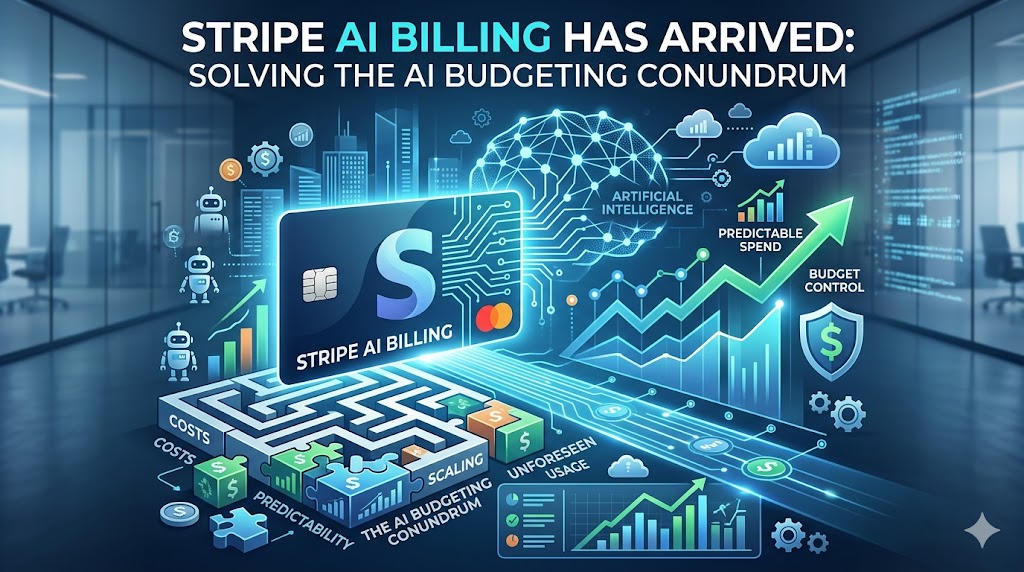
Stripe AI Billing It feels like just yesterday when Artificial Intelligence was a concept confined to science fiction novels and research labs. Fast forward to today, and AI is no longer a futuristic dream; it’s an integral part of our daily lives and, more importantly, a powerful engine for business innovation. From powering your favorite streaming service recommendations to optimizing complex supply chains, AI is everywhere. And with this explosive growth comes an equally explosive wave of potential – but also, a daunting challenge: budgeting for AI. We’re talking about the kind of costs that can make even seasoned CFOs break into a cold sweat.
The AI Boom: Innovation Meets Unpredictable Costs
The sheer speed at which AI capabilities are evolving is astounding. New models, more powerful algorithms, and increasingly sophisticated applications are emerging at a breakneck pace. Businesses are eager to harness this power to gain a competitive edge, streamline operations, and unlock new revenue streams. However, this AI revolution is like a race car – incredibly fast and exciting, but without a proper governor, it can easily spin out of control, especially when it comes to financial planning.
Understanding the AI Cost Challenge
The core of the problem lies in the inherent nature of AI development and deployment. Unlike traditional software or services with predictable usage patterns, AI often operates in a realm of dynamic and sometimes opaque resource consumption. This makes it incredibly difficult to pin down exact costs before they’ve already been incurred.
Variability in AI Usage
Think about it: a simple query to a large language model might cost pennies, but running complex simulations, training new models, or processing massive datasets can quickly rack up significant expenses. The demand for AI resources can fluctuate wildly based on user activity, model complexity, and the sheer ambition of the projects being undertaken. This isn’t a fixed monthly subscription for a streaming service; it’s more like a utility bill that can skyrocket without warning.
The “Black Box” of AI Spending
For many organizations, understanding exactly where their AI budget is going can feel like peering into a black box. Costs can be tied to cloud computing hours, API calls, data storage, specialized hardware, and the talent required to manage it all. Without clear visibility into these granular components, forecasting and controlling AI expenditure becomes an educated guess at best, and a financial gamble at worst. This uncertainty can stifle innovation, as teams might hesitate to explore new AI applications for fear of blowing the budget.
Enter Stripe AI Billing: A Game Changer for Budgets
This is precisely where Stripe AI Billing steps in, poised to transform how businesses manage their AI-related expenses. Stripe, a name synonymous with seamless online payments and financial infrastructure, has now turned its formidable expertise towards solving AI’s biggest budget headache. This isn’t just another billing feature; it’s a strategic solution designed to bring predictability, control, and intelligence to AI spending.
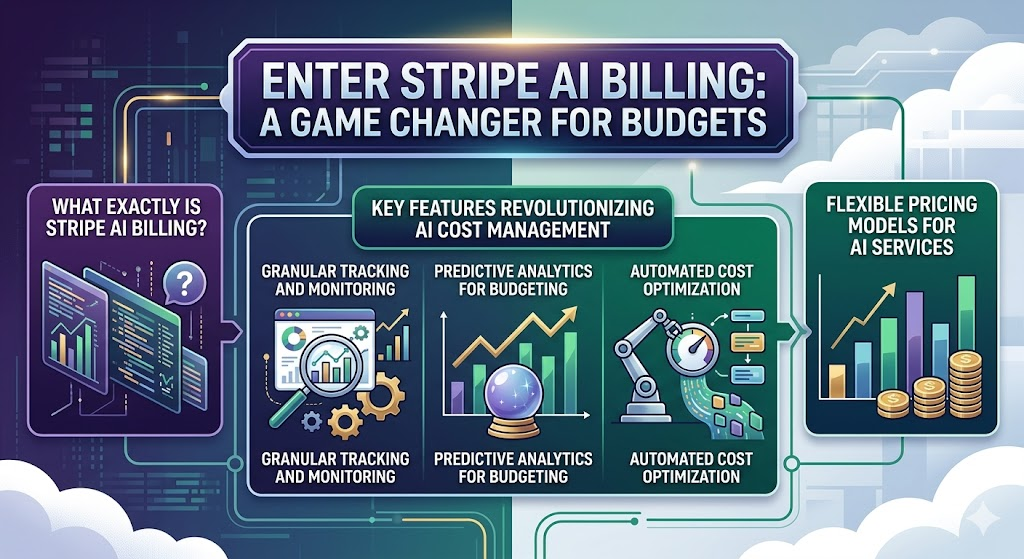
What Exactly is Stripe AI Billing?
At its heart, Stripe AI Billing is a sophisticated system designed to provide businesses with unprecedented insight and control over their AI costs. It goes beyond traditional billing by deeply understanding the nuances of AI resource consumption. Imagine having a financial co-pilot for your AI initiatives, constantly monitoring, analyzing, and optimizing your spending. That’s the essence of what Stripe AI Billing aims to achieve.
Key Features Revolutionizing AI Cost Management
Stripe AI Billing is packed with features that directly address the pain points of AI budgeting. Let’s dive into what makes it so powerful:
Granular Tracking and Monitoring
This is perhaps the most critical aspect. Stripe AI Billing allows you to track AI costs at a microscopic level. Whether it’s per API call, per processing unit hour, or based on the complexity of the model used, you get detailed breakdowns. This means you can finally see what is costing how much, eliminating those frustrating “where did all the money go?” moments. It’s like having an x-ray into your AI expenditure.
Predictive Analytics for Budgeting
Forecasting AI costs has always been a challenge. Stripe AI Billing leverages data analytics to provide more accurate predictions. By analyzing historical usage patterns and understanding the cost implications of different AI services, it can help you forecast future spending with much greater confidence. This allows for proactive budget allocation, rather than reactive scrambling.
Automated Cost Optimization
This is where the “smart” in AI billing truly shines. The system can identify potential areas of overspending or inefficiencies. It might suggest switching to a more cost-effective model for certain tasks, optimizing resource allocation, or flagging underutilized AI services. This automation can lead to significant savings without requiring constant manual oversight. Think of it as having an AI assistant dedicated to saving you money on your AI initiatives.
Flexible Pricing Models for AI Services
Stripe AI Billing is built to accommodate the diverse and evolving pricing structures of Stripe’s usage-based billing for AI services. Whether it’s pay-as-you-go, tiered pricing, or custom enterprise agreements, the platform can handle it. This flexibility is crucial for businesses that utilize a variety of AI tools and platforms, each with its own unique cost structure. It centralizes your AI financial management, simplifying complexity.
How Stripe AI Billing Empowers Businesses
The impact of Stripe AI Billing extends far beyond just tracking numbers. It fundamentally changes how businesses can approach and leverage AI technology.
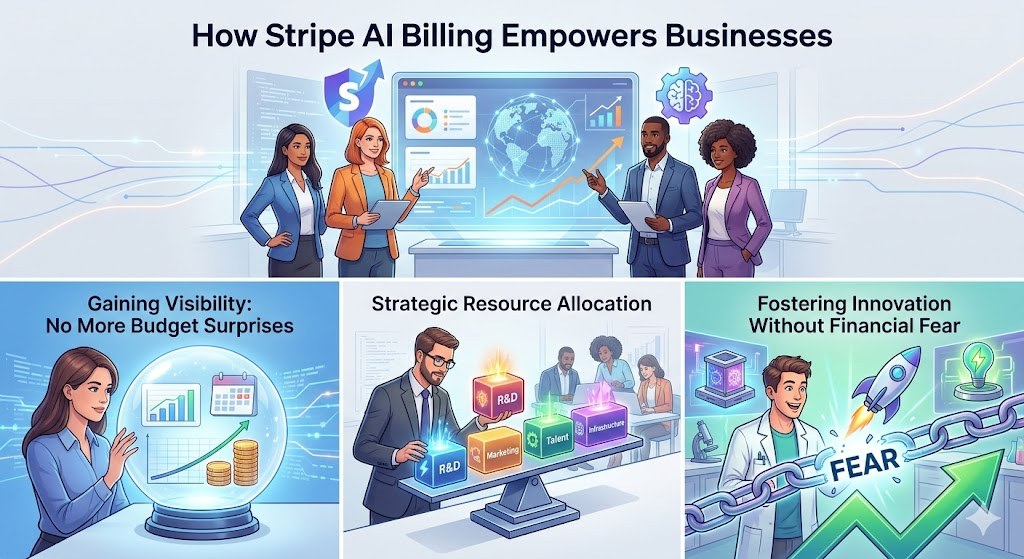
Gaining Visibility: No More Budget Surprises
The most immediate benefit is the eradication of unexpected AI cost overruns. With clear, real-time visibility into AI spending, finance teams and project managers can stay on top of budgets. This transparency builds trust and allows for more informed decision-making. Gone are the days of end-of-month budget shockwaves originating from AI projects.
Strategic Resource Allocation
Understanding where your AI budget is being spent allows for smarter resource allocation. You can identify which AI initiatives are delivering the most value for their cost and which might need re-evaluation. This ensures that your investment in AI is aligned with your business objectives, maximizing ROI. It’s about making your AI dollars work harder and smarter.
Fostering Innovation Without Financial Fear
Perhaps the most profound impact is on innovation. When the fear of runaway AI costs is mitigated, teams are more likely to experiment with new AI applications, explore cutting-edge technologies, and push the boundaries of what’s possible. Stripe AI Billing acts as a safety net, allowing for bolder, more ambitious AI projects to be undertaken with financial confidence. It liberates your R&D teams to be creative without being constrained by budget anxieties.
Real-World Impact: Case Studies (Hypothetical)
To truly grasp the power of Stripe AI Billing, let’s look at a couple of hypothetical scenarios:
Scenario 1: A Growing SaaS Startup
“InnovateNow,” a rapidly growing SaaS startup, was experiencing a surge in user adoption. Their platform heavily relied on AI for personalized user experiences and predictive analytics. However, their cloud AI costs were spiraling, making profitability a distant dream. After implementing Stripe AI Billing, they gained real-time insights into API usage and model execution costs. They discovered that a specific AI feature, while popular, was disproportionately expensive to run. With this data, they optimized the underlying model and introduced a tiered pricing strategy for premium AI features, bringing their AI expenditure under control and significantly improving their profit margins.
Scenario 2: An Established Enterprise Embracing AI
“GlobalCorp,” a large manufacturing firm, was investing heavily in AI for supply chain optimization and predictive maintenance. They had multiple teams working with various AI platforms, leading to fragmented spending and little oversight. Stripe AI Billing provided them with a unified view of all AI costs across the organization. They identified redundant AI services being used by different departments and consolidated them. Furthermore, the predictive analytics helped them forecast peak AI usage periods, allowing them to negotiate better rates with cloud providers and avoid costly spot instances during high demand. This strategic approach saved GlobalCorp millions annually, making their AI initiatives sustainable and scalable.
The Future of AI Finance: Beyond Billing
Stripe AI Billing is more than just a tool; it’s a glimpse into the future of financial management in the age of AI. As AI becomes more embedded in business operations, the need for intelligent financial tools will only grow.
Integration with Existing Financial Workflows
The true power of Stripe AI Billing lies in its potential for seamless integration. Imagine it feeding directly into your ERP systems, accounting software, and budgeting tools. This creates a holistic financial ecosystem where AI costs are managed with the same rigor as any other business expenditure, fostering greater efficiency and accuracy.
The Role of AI in Financial Forecasting
As Stripe AI Billing matures, we can expect it to become even more sophisticated. It will likely evolve to incorporate more advanced AI techniques for financial forecasting, risk assessment, and even automated budget optimization based on market trends and business performance. The AI that helps us build is also helping us manage the cost of building. It’s a virtuous cycle.
Conclusion: Embracing the AI-Powered Financial Revolution
The advent of AI has unlocked unprecedented opportunities for innovation and growth. However, the unpredictable nature of AI costs has long been a significant barrier, casting a shadow of financial uncertainty over these exciting advancements. Stripe AI Billing is not just a new product; it’s a fundamental solution that tackles this challenge head-on. By providing granular visibility, predictive analytics, and automated optimization, it empowers businesses to harness the full potential of AI without the fear of budget blowouts. This is a critical step forward, allowing Billing tools for AI companies to innovate freely, scale responsibly, and truly capitalize on the transformative power of Artificial Intelligence. It’s time to embrace the AI-powered financial revolution and build the future, one well-managed dollar at a time.
Frequently Asked Questions (FAQs)
1. How does Stripe AI Billing differ from traditional billing systems?
Traditional billing systems typically focus on the transactional aspect of sales. Stripe AI Billing, on the other hand, is designed to understand the complex, variable, and resource-intensive nature of AI services. It provides granular tracking, predictive analytics, and optimization tools specifically tailored to AI expenditure, offering much deeper insight and control than standard billing.
2. Can businesses of any size benefit from Stripe AI Billing?
Absolutely! While large enterprises with extensive AI deployments will see significant advantages, smaller businesses and startups that are beginning to leverage AI tools can also benefit immensely. It helps establish good financial practices from the outset, preventing future budget surprises as their AI usage grows.
3. Does Stripe AI Billing integrate with popular cloud AI platforms like AWS, Google Cloud, or Azure?
While specific integration details may evolve, the goal of Stripe AI Billing is to provide a unified view of AI costs, regardless of the underlying platform. It’s designed to ingest and analyze data from various AI service providers, acting as a central hub for managing AI spend across different cloud environments.
4. How does Stripe AI Billing help in optimizing costs beyond just tracking?
Stripe AI Billing incorporates automated features. For example, it can flag underutilized AI resources, identify costly usage patterns, and suggest more cost-effective alternatives. It might also facilitate the implementation of flexible pricing models that align better with actual AI service consumption, leading to direct savings.
5. Is Stripe AI Billing a one-time purchase, or is it a subscription service?
Stripe AI Billing is typically part of Stripe’s broader financial services offerings. Businesses usually pay based on their transaction volume and the specific features and services they utilize within the Stripe platform, including AI billing capabilities. It’s an ongoing service designed to continuously support your AI financial management .
Pingback: Returned Mobile ACH Payments in 2026: A Comprehensive Guide
Pingback: How AI Outbound Calling Agents Boost Sales Efficiency: Unlocking Success
Pingback: Mobile ACH Payments vs Credit Cards: Which Is Better?
Pingback: Grok Image & Video Credit Cost Exact Pricing and How to Spend Less